
















Before Harper Syres, a student at CT State Community College Manchester, reaches class, the U-Pass has already made one calculation easier.
There are still a route and schedule to check and a day of classes ahead. Luckily for Syres, the pass removes one financial constraint from the commute before the school day even begins.
“I use the U-Pass every single day to get to work, to get to school, to get my internship,” Syres said.
Syres is one of an estimated 1,000 students each semester who use the U-Pass, according to the CT State Manchester Bursar’s Office. The U-Pass CT program launched in 2017 through the Connecticut Department of Transportation, the University of Connecticut and Connecticut State Colleges and Universities. The program’s initial rollout included 15 participating schools: four UConn campuses, nine community colleges and two state universities, including what was then known as Manchester Community College. The program has since expanded to include 10 CT State Community College campuses, the four state universities and six UConn locations.
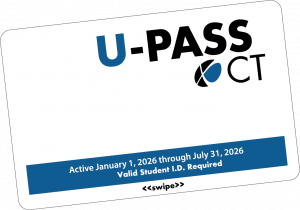
The pass allows eligible college students to use public transportation across Connecticut at no
additional cost outside of the student transportation fee. For students whose financial aid covers
their fees, the U-Pass can come with no extra out-of-pocket cost. Students can use it on
CTtransit local and express buses, CTfastrak, CTrail Shore Line East, the CTrail Hartford Line,
Metro-North’s New Haven Line within Connecticut and select Amtrak trains between New Haven and Springfield, Mass.
“Programs like the CT U-Pass are important because they provide students with affordable and reliable transportation options,” said Paige Lawrence, Outreach and Engagement Specialist for CTrides. “Not every student has access to a personal vehicle, and transportation challenges can make it harder to get to class, work, internships, or other important destinations. The U-Pass helps remove some of those barriers…”
Students on the Manchester campus can get a U-Pass from the Bursar’s Office on the first floor of the Student Services Center building with their Banner ID. Those whose financial aid covers the student transportation fee, or who have already paid the fee, are eligible to receive one. The U-Pass needs to be renewed each semester. The current pass expires July 31, 2026.
Syres’ reliance on the pass is also tied to a larger transportation constraint.
“I don’t have a driver’s license, so when I need to go somewhere, I do rely on public transportation,” she said.
Syres said the pass has helped her travel through Manchester, Hartford and Vernon, with train access opening longer routes across Connecticut.
“It can get me all the way up to Springfield for free,” Syres said. “For New York, I can get all the way to the state line with my U-Pass for free.”
The U-Pass can also lower the cost of longer trips outside of Connecticut. An off-peak one-way Metro-North ticket between New Haven Union Station and Grand Central Terminal costs $19.25.
Since the U-Pass is valid on the New Haven Line within Connecticut, students traveling to or from Manhattan would only need to buy a ticket between Greenwich and Grand Central Terminal, which costs $11. That saves $8.25 on a one-way off-peak trip.
Syres described the pass as a reliable part of her routine.
“It is an extremely useful tool,” Syres said. “I’ve never had an issue with taking a bus or a train with my pass.”
CTDOT’s most recent statewide data offers a partial look at U-Pass usage in 2023, though it does not provide an exact student count. The agency’s 2023 Fare Equity Analysis shows the
pass accounted for 68,247 annual fare media purchases, making up 6.2% of CTtransit fare media purchases included in the report.
The same report also found that 13.5% of CTtransit survey respondents used U-Pass as their fare. Since the data counts fare purchases and survey responses, the figure reflects U-Pass
activity rather than the number of individual students who used the program.
While the program has already grown from its initial rollout into a benefit available across much of Connecticut’s public higher education system, awareness is still a challenge, said Lawrence.
U-Pass information is visible through posted flyers across campus, on social media and word of mouth. But not everyone who can benefit from it knows about it, Lawrence said.
“Especially for new and incoming students who may not be familiar with the public transportation options available to them,” she said. “CTrides helps promote the CT U-Pass through outreach efforts at colleges and universities across the state. Through the Road Scholar program, we share customized transportation information with each school community, attend events, and help students learn how to use available transit services, including the CT U-Pass program.”
For more information about the U-Pass program visit https://ctrides.com/u-pass-ct-for-students/.